
The Erzya have launched their own infrastructure for learning their language
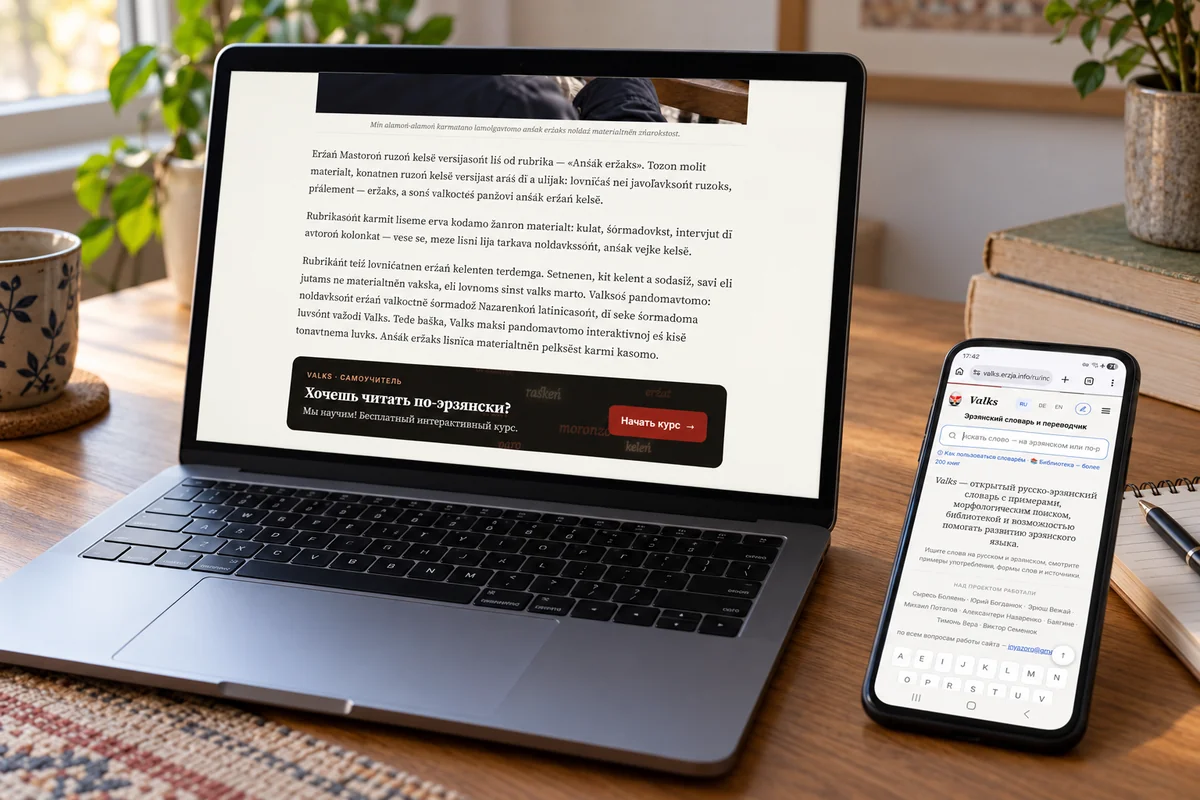
A reader of the Russian-language edition of Erźań Mastor reaches the end of a short report on staff cuts at a school in Ardatov, a town in the Republic of Mordovia, and finds two boxes at the bottom of the page. The first says: "This article is available in Erzya." The second, on a dark background, reads: "Want to read Erzya? We'll teach you! A free interactive course." Its "Start the course" button leads to the Valks self-study course. Open the Erzya version of the same report, and a switcher with two links appears above the text: "Vese valkoct" (full text) and "Šožda valkoct" (simple text).
Erźań Mastor is an independent online publication that continues the print newspaper of the same name (the title means "Erzya Land"). According to the publication's own page, the paper first appeared in 1994 and was founded by two veterans of the Erzya national movement, Nuyan Vidyaz and Kshumantsyan Pirguzh. Today the site appears in Russian and in Erzya, a Finno-Ugric language spoken mainly in Mordovia and neighbouring regions of Russia. Erzya texts are printed in the Latin-script orthography developed by Aleksandr Nazarenko. The paper's archive for 2003–2012 (235 issues, 1,652 articles) has been published on Wikisource under a CC BY 4.0 licence.
The simple text is the newest addition to the site's news. A note next to the switcher explains it in Erzya: "Šožda valkoct — seke žo kuľaś, jovtaź nuŕkinestë dï šožda valso, erźań kelen tonavtnićatnen turtov" — the same news, told briefly and in simple words, for people learning Erzya (our translation). Below the simple text sits a short glossary. For the Ardatov school report it includes, for example, kirťams ("to cut, reduce") and lomańlovoma ("census"). According to the description the Erźań Mastor editors shared with Valks, the simple version is aimed at readers at level A2 of the European language framework. Not every news item gets one, and none is published until a native speaker has signed it off.
The second innovation is a section called "Anśak erźaks" ("Only in Erzya"). The publication announced it on 28 September: readers of the Russian edition see the headline and a teaser, but the article itself opens only in Erzya, and no Russian translation exists. On the Russian-language home page the section has its own block with a "Read in Erzya" button.
The third link in the chain is the course itself. The Valks self-study course consists of 24 lessons in eight sections and takes learners from level A1 to A2. Its main script is Latin, with Cyrillic given as a prompt. The course includes dialogues voiced by native speakers, reading texts and an Anki flashcard deck for vocabulary review.
Together, these pieces form a ladder. Someone who cannot read Erzya works through the course up to A2, then moves on to news in the simple version, and from there to the full text. Words from a simple text's glossary can be looked up in the Valks dictionary, where they are not only translated but also voiced, so the learner hears how each word sounds. And because some material is available only in Erzya, there is one more reason to keep climbing. The key feature of the scheme is the short step between textbook and real text: this is exactly where many learners give up. The Finno-Ugric world already knows a similar path. Yle, Finland's public broadcaster, has published news in simple Finnish since 1992. As Yle itself writes, these were first made for second- and third-generation Finns abroad who were losing the language. The Erzya situation is close to that: many Erzya adults understand their parents' speech but cannot read in their mother tongue.
We looked for similar combinations among other peoples of Russia. Tatar has by far the richest set of resources: apps, online schools, a self-study book released by the Tatar Book Publishing House in 2022, and a lesson series, "Tatar for Every Day", on the website of Azatliq, Radio Free Europe/Radio Liberty's Tatar-Bashkir service, which includes a lesson on understanding the news in Tatar. However, in open sources we were unable to find any publication in the language of an Indigenous people of Russia that issues news at two levels of difficulty and leads readers from the news page directly to a course. If such an example exists, we would be grateful for a link and will report on it.
It is also worth saying what this system rests on. It was built not by a school, a university or a state publishing house, but by Kirdijur, the Erzya system of national self-government endorsed by the Erzya National Congress in 2022. It was the national movement that planned, funded and launched the system. Its bottleneck is the native speakers who certify each simple text: there are few of them, which is why not every news item has a simple version. It does not replace school teaching of Erzya. But it gives adults something they did not have before: regular reading in Erzya that is manageable from the first months of study.
A note from Valks. Erźań Mastor and Valks belong to the same family of erzja.info projects, and the course the banner leads to is our own. That is why we describe how the system works rather than judge its quality. What follows for us: we will check the glossaries of the simple texts against the Valks dictionary, so that every word a learner meets in the news can be found here. We will also track how many readers come to the course from Erźań Mastor and at which lesson they stop. Once there is enough data, we will publish it.