From «Šumbra či!» to the objective conjugation: inside the Valks Erzya course
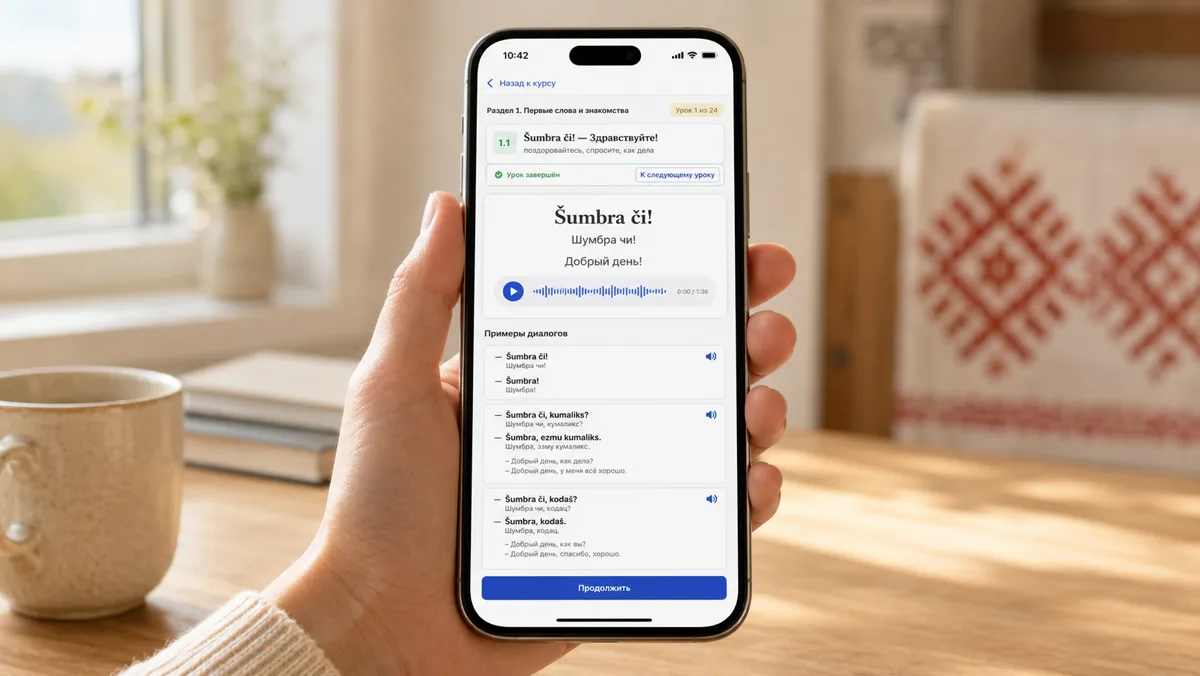
The first thing a beginner hears in the Valks self-study course is not a rule or a table but a living scene: a young man and a young woman meet in the street, and the words «Šumbra či!» — "Good day!" — ring out. That phrase opens 24 lessons that take a learner from zero to level A1–A2 in Erzya, a Finno-Ugric language spoken mainly in the Republic of Mordovia and neighbouring regions of Russia. Here is how the course works, and why we believe it is the most practical way there is to start speaking Erzya.
The course is divided into eight units of gradually increasing difficulty: first words and introductions, questions of who you are and where you are from, numbers and time, talking about the Erzya people, village and city, family and possessive forms, stories from life, everyday routines and shopping. Grammar enters the lessons not as lists of paradigms but as the plot requires it: the definite declension appears where something must be named precisely, the past tense where the characters reminisce, the objective conjugation where an everyday sentence cannot be built without it. By the end of the course all the fundamentals of Erzya grammar have been covered — learned through situations rather than memorisation.
The course's main strength is sound. All dialogues are recorded by native speakers, and each lesson is built around listening: first hear the whole scene, then repeat after each character, then play a role yourself. For a language that is rarely heard outside the family and the stage, this matters fundamentally: from day one the learner hears real Erzya speech instead of reading a transcription off the page.
The second feature is the script. The course is taught consistently in the Erzya Latin alphabet; a Cyrillic rendering is given as a hint on the second line, with a Russian translation on the third. A separate reference explains how to read the special characters. The course thus builds the habit of the script used across the whole portal without abandoning those used to Cyrillic-based publications. (The course itself is taught with Russian as the language of explanation.)
The third pillar is the link to the dictionary. Every Erzya word in a lesson is clickable and leads to the corresponding entry in the Valks dictionary, which today contains more than 26,000 entries, including material from Heikki Paasonen's dictionary. The course and the dictionary work as a single system: meet a word in a dialogue, and its forms, meanings and examples are one step away. No printed textbook can offer that connection.
Finally, the course is designed for self-directed learning without outside supervision. Each unit ends with a practice session — "speak without prompts, using the words you have learned"; lessons close with a spoken self-check; and all the phrases of the course can be downloaded as a single file for Anki, the spaced-repetition app that reminds you when it is time to review. The course is free, requires no registration and is open from any device.
The course is part of the same work as the dictionary: a language is preserved not by declarations but by tools that can be used every day. Valks will keep expanding the course — above all with new audio recorded by native speakers — and invites learners to send questions and comments: they directly shape what the next lessons will be.
You can start right now, with your first «Šumbra či!»: Erzya language lessons.