Lovńaśke on the big stage: the Erzya language in a new musical
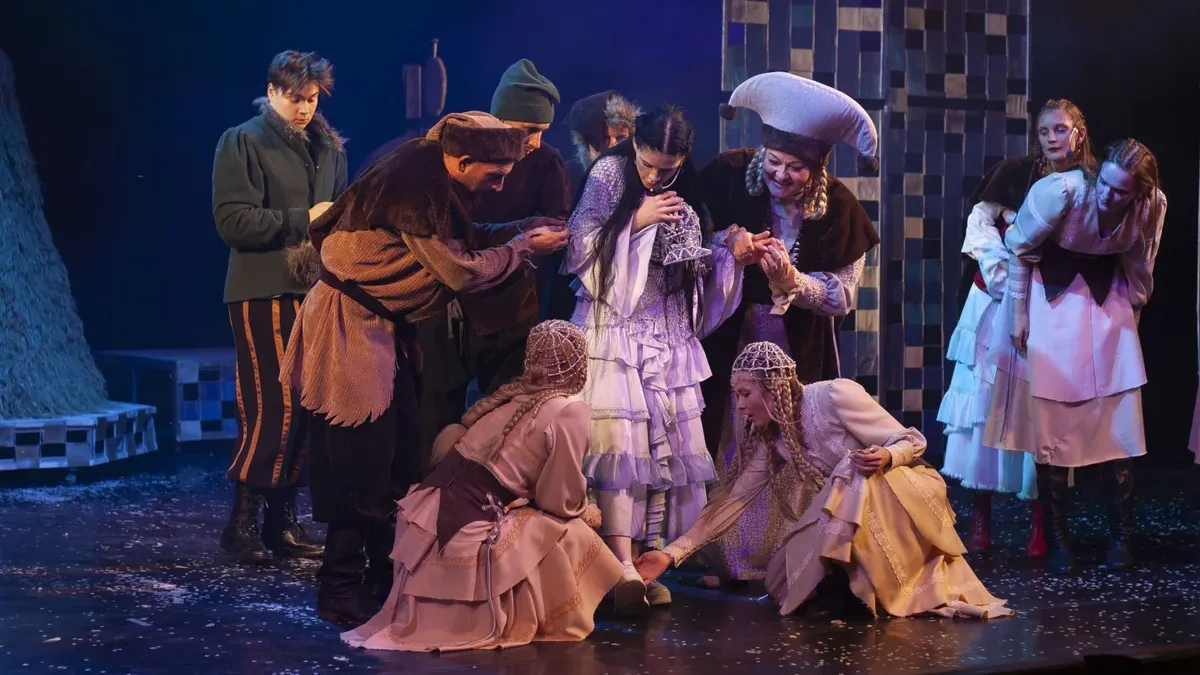
In Saransk, the capital of the Republic of Mordovia, Alexander Ostrovsky's play The Snow Maiden (Snegurochka) has been staged in Erzya, a Finno-Ugric language spoken mainly in Mordovia and neighbouring regions of Russia. The first performances of Lovńaśke took place on 22 and 23 October at the Mordovian National Drama Theatre. The new production combines dramatic text, music and movement, and adds one more show to the repertoire that audiences can attend to hear Erzya spoken.
The theatre describes the genre as a fairy-tale musical. The show is intended for family audiences, carries a 12+ age rating and runs two hours and ten minutes with an interval. Simultaneous translation into Russian is available for viewers who do not speak Erzya.
A musical story in Erzya
The production is directed by Oleg Yumov and designed by Seseg Dondokova, both of whom have ties to the Buryat Drama Theatre. The music was written by Darya Korkina, the movement was staged by Maria Lychkovskaya and the lighting is by Alyona Rumyantseva. Two actresses, Kristina Pavlova and Olesya Pestova, are cast as the Snow Maiden.
The production had been in preparation since spring. In May, the theatre magazine Teatral reported on work on an Erzya version of the play, with a premiere planned for October. In summer, the newspaper Izvestiya Mordovii wrote about the specially composed music and costumes inspired by traditional Erzya dress. The project therefore involved not only translating the lines but also creating the production's musical and visual world.
Musical theatre makes its own demands on language. The text has to work in speech, movement and song, and remain intelligible as tempo and intonation change. For the language, this is an important aspect of the premiere: Erzya becomes part of a complex professional performance in which words are tied to the actor's voice, the music and the rhythm of the stage.
The question of genre novelty, however, calls for caution. In its announcement the theatre describes the show as the first musical in Erzya. We have no independent confirmation that it is historically the first. The new musical production matters even without that label.
A name with its own history
The name Lovńaśke existed long before this premiere. In the collection Erźań jovkst ("Erzya Tales"), compiled by Makar Evseviev and published in Moscow in 1928, a tale of the same name appears on pages 38–39.
In this recorded tale, a childless old couple make a child out of snow. The girl comes to life, is named Lovńaśke and grows up in their home. When the warm weather arrives she becomes sad, and then melts in the sun. The name and the image of the snow girl have thus been part of published Erzya folklore for almost a century.
This is a separate text and should not be equated with Ostrovsky's play. The theatre names the playwright's work as its literary source; there is no evidence that the director and his team drew on Evseviev's record. But for Erzya readers the title has a history of its own that reaches beyond the new poster.
Ostrovsky in Erzya since the 1930s
Ostrovsky translations have a history of their own, too. A bibliographic guide by the National Library of Mordovia lists Erzya editions of The Storm (Purgeńks) and Poverty Is No Vice (Bednoj-čiś avoľ asatyks). Both books were published in Saransk in 1935.
This context helps to see the October premiere more precisely. Turning to Ostrovsky continues a long translation tradition, and the new musical form offers another way to develop it. Every such production also involves language work: choosing words, editing the text for the stage and fitting it to the performance.
Who did this work for Lovńaśke is not clear from the published listing of the show. It names the creative team and the cast but not the author of the Erzya translation, nor the author of the song lyrics. This information matters for the history of the production: translation and work on the language are as much a part of its creation as the music, costumes and lighting.
After the opening nights
As of 30 October, Yandex Afisha lists further performances on 3 November at 19:00 and 26 November at 18:30. The new production is part of the theatre's ongoing schedule; there is not yet any verified information on attendance or audience response.
For the Erzya language, what matters most is the chance to return to the stage. Repeat performances give audiences new occasions to hear the language outside the home and the classroom. The Russian translation also means that people with different levels of Erzya can come together.
A single premiere does not change the language situation. But it creates a concrete opportunity: an evening at the theatre in which Erzya carries the dialogue, the characters and the drama. How long Lovńaśke stays on stage will become clear in the seasons ahead.