
Erzya from Scratch: the self-study book is out. What it offers beginners
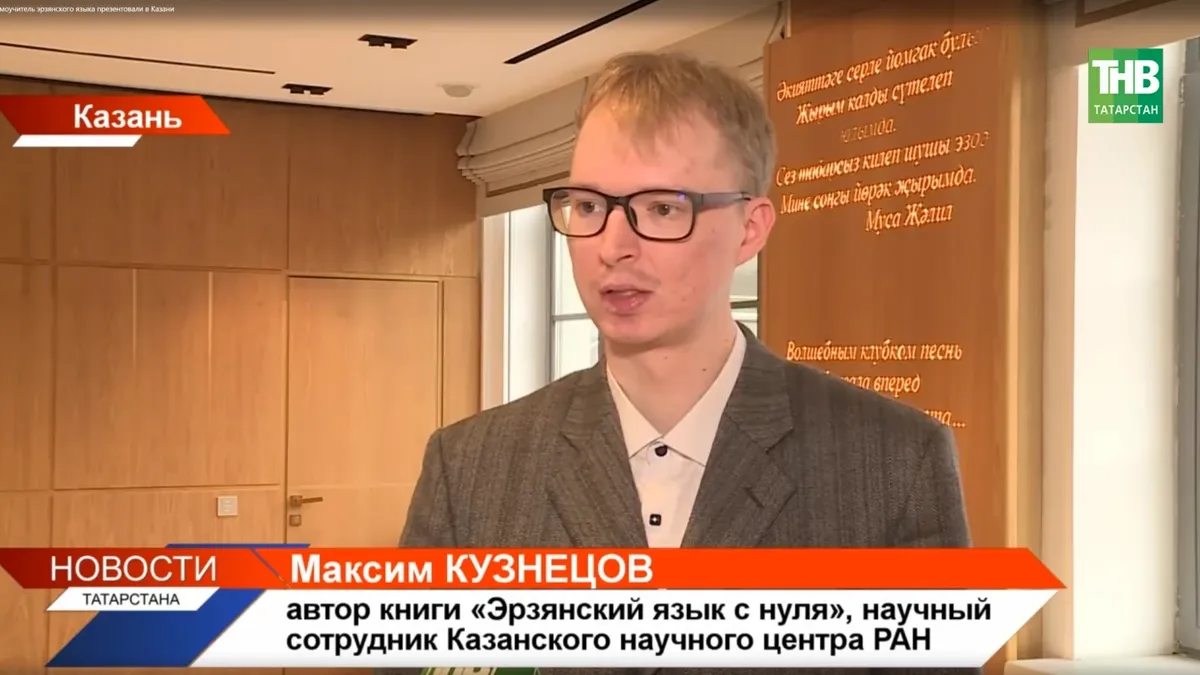
The Tatar Book Publishing House in Kazan has released Erzya from Scratch: A Self-Study Book for Beginners («Эрзянский язык с нуля: самоучитель для начинающих») by Aleksei Arzamazov and Maksim Kuznetsov. The book can already be ordered from the publisher's online shop. People who want to learn Erzya — a Finno-Ugric language spoken mainly in the Republic of Mordovia and neighbouring regions of Russia — on their own now have one more route, with grammar explanations, learning texts and dialogues. How easy it is to follow without a teacher remains to be tested on the book itself.
In July, Valks reported on the book's preparation. Its release has now been confirmed: the Kazan Scientific Centre of the Russian Academy of Sciences (KazSC RAS) announced it on 9 October. The publisher scheduled a presentation in Kazan for 15 October, and on 16 October the Tatarstan TV channel TNV published a report on the event.
Both authors work at the KazSC RAS Laboratory of Multifactor Humanities Analysis and Cognitive Philology: Arzamazov heads it, and Kuznetsov is a research fellow. The book is the sixth in the series Languages and Cultures of the Peoples of the Republic of Tatarstan. Its publication was supported by the republic's commission for the preservation and development of the Tatar language and the native languages of the peoples living in Tatarstan.
From first sounds to complex forms
The publisher's description promises to combine grammar study with conversation from the very first lessons. The KazSC announcement is more specific about the content: phonetics, tables of noun and verb forms, grammar exercises, and specially prepared learning texts and dialogues. It also covers the objective conjugation, the part of Erzya grammar in which verb forms carry information about the participants in an action.
The idea deserves attention: a beginner needs to move from isolated phrases to an understanding of how the language works. A memorised greeting lets you start a conversation; a system of explanations and exercises should help you continue it in your own words. The question is how consistently the book builds that transition.
KazSC also claims that the book has exceptional advantages and contains tables "without analogues". This is the assessment of the institution where the authors work. Accepting it as established fact would require a comparison with earlier textbooks and an independent review by language-teaching specialists. The available descriptions do not allow such a conclusion.
What we know about buying it
At the time of checking, on 30 October, the Tatar Book Publishing House shop offered the book for 900 roubles. The listing gives 173 pages, a hardcover, Russian and Erzya as the languages, and an age rating of 12+. The ISBN is 978-5-298-05081-4.
The listing marks "E-book: No". It gives no information about audio material, answer keys or the expected learning outcome.
For a self-taught learner these are important questions. Audio lets you match the written word to its pronunciation; answers help you spot mistakes; a clear sequence of lessons helps you plan your work. The label "self-study book" alone does not explain how this support is organised.
One more path to Erzya
The book enters an existing learning landscape. Earlier materials include Kortatano erźaks — Let's Speak Erzya by Nina Aasmäe, published in Tartu in 2015. It is available in the Valks library, and some of the site's lessons are built on it. It would therefore be wrong to call the Kazan book the first way to start learning Erzya on your own.
Valks develops its own course, and we do not treat it as an independent benchmark for judging the new book. Different learning formats can have different strengths: a printed book suits step-by-step work and returning to grammar, while digital materials are better for listening and quick word searches. Their quality should be compared lesson by lesson and by learners' results.
The confirmed outcome of October is that the new book has been published and is on sale. The next meaningful step is to see how it works: whether a beginner can get through the first lesson, check their own progress and use what they have learned in conversation or reading. Only such a test will show what the book adds to the ways of learning Erzya.