Why twenty in Erzya: the first Languages Day dictation at Saransk's teacher-training university
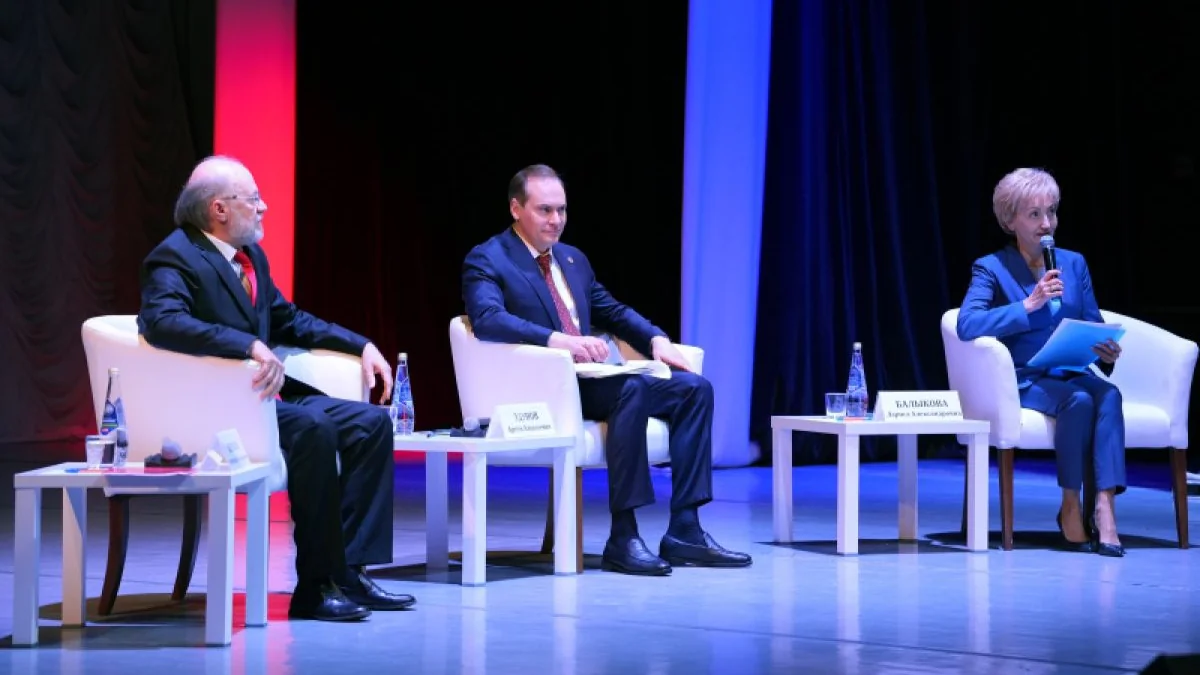
On 8 September 2026, the first official Day of the Languages of the Peoples of Russia, the Evsevyev Mordovia State Pedagogical University in Saransk held the dictation "Russia — Home of Peoples" in three languages. According to the university, of 105 papers written, 60 were in Russian, 25 in Moksha and 20 in Erzya — the Finno-Ugric language of the Volga region to which this portal is devoted. Twenty papers — at the republic's main teacher-training university, where Erzya is a state language under the constitution and where its future teachers are trained. This article is an attempt to understand what such a number is made of.
The event itself was nationwide and ceremonial. The dictation was organised by the House of the Peoples of Russia and the online encyclopaedia RuWiki, with the support of the Federal Agency for Ethnic Affairs, the Institute of Linguistics of the Russian Academy of Sciences and the Total Dictation foundation — to mark the Day of the Languages of the Peoples of Russia, established by presidential decree No. 798 in November 2025 and observed this year for the first time. The date coincides with the birthday of the poet Rasul Gamzatov, so all the language versions are translations of a passage of his prose about the mother tongue. According to the organisers, more than 7,600 venues were registered across 88 regions, and 21 languages, Russian included, were available online. No nationwide results broken down by language have been published; nor has anyone named the author of the Erzya translation of Gamzatov's text — or its editor, its reader, or the marking procedure. This is the second September story in which an Erzya text exists without a name: the day before we wrote about a commercial Erzya course whose author is likewise unnamed.
Of course, the numbers of a single venue measure neither command of the language nor interest in it. The university has not disclosed who the 105 participants were, whether registration was open, whether people came in organised groups or whether seats were limited; the event was held for the first time, so there is nothing to compare it with. To the twenty who wrote in Erzya there are no questions at all — they came and they wrote. The question lies elsewhere: why, at a university that has run a Centre for the Promotion of Native Languages and Literature since 2019 and where the department of native language and literature is a core unit, does the expected outcome of a festival day amount to twenty Erzya papers?
The answer is assembled from links in a chain, most of which we have described before. School: since 2018, native languages in Russian schools have been optional, taught only on a parent's application — and we have told how the hundred-year history of Erzya as a school subject ended in its removal. Family: the state has effectively shifted the transmission of the language onto the family while removing its incentives — that was our article on the "grandmother's silence". Numbers: according to Fenno-Ugria, an Estonian NGO monitoring the Finno-Ugric peoples of Russia, the count of those who spoke Erzya or Moksha across Russia fell by a third between the censuses of 2010 and 2021 — 431,196 against 280,046. The teaching pipeline: at the national final of the competition for teachers of native languages, which closes these days in Lipetsk, Mordovia's schoolteacher is a teacher of Moksha, while an Erzya teacher who reached the final works not in Mordovia but in Dimitrovgrad, in the Ulyanovsk region. Twenty papers at the specialised university are neither an anomaly nor an accident; they are the expected link in the same chain.
Against this background, the two dimensions of the festival come apart. The ritual dimension is growing: a new day established by decree, thousands of venues, a dictation held at a university in a republic whose constitution names its languages state languages — in the official formula "the Mordvin (Moksha, Erzya) languages", behind which stand two languages in their own right. The practical dimension is shrinking: the subject is optional, the teachers are few, the translator of the festival text is unnamed, and no one publishes results by language. The dictation honestly showed the ratio of these two dimensions in a single number. The precipice does not begin in the room where twenty people wrote — it begins in the school where Erzya ceased to be compulsory, and in the family that was left with the responsibility but without the support.
On 17 September the department of native language and literature will hand participants their results; if the Erzya reference text is published, we will examine it together with native speakers. Valks will go on counting not the papers written at festival venues but what stands behind them: the hours of Erzya taught in schools, the intake and graduation of its future teachers, the fate of the twenty people who came to write. For them — and for everyone this day prompted to test themselves — our dictionary and free self-study course are open all year round: a language rests not on dates in a calendar but on those who speak and write it on the other three hundred and sixty-four days.