
Erźań Mastor: a €39 Erzya course — a third made by AI, no author named
On 4 September 2026, the outlet Erźań Mastor reported that ANLHE (Ancient & New Language Heritage Education), a Lithuania-based online service, is selling a course in Erzya — the Finno-Ugric language of the Volga region to which this portal is devoted — for €39, with no author's name, no sample lesson and no indication of which writing system the course uses. The publication wrote to the company twice and obtained direct answers: roughly a third of the course was produced by generative AI, the material was checked by an unnamed native speaker, and which alphabet is taught the buyer learns only after paying.
ANLHE describes itself as a platform for structured online instruction in living, heritage and historical languages and gives an address in Vilnius. Its home page claims 444 courses and 4,440 lessons. According to Erźań Mastor, there was no trace of the service online before late August, and the pages the editors checked — the Erzya, Moksha and Proto-Uralic courses — were all published on a single day, 25 August; the site has been taking orders since that same day. There is no founding year, no student numbers and no teachers' names on the site.
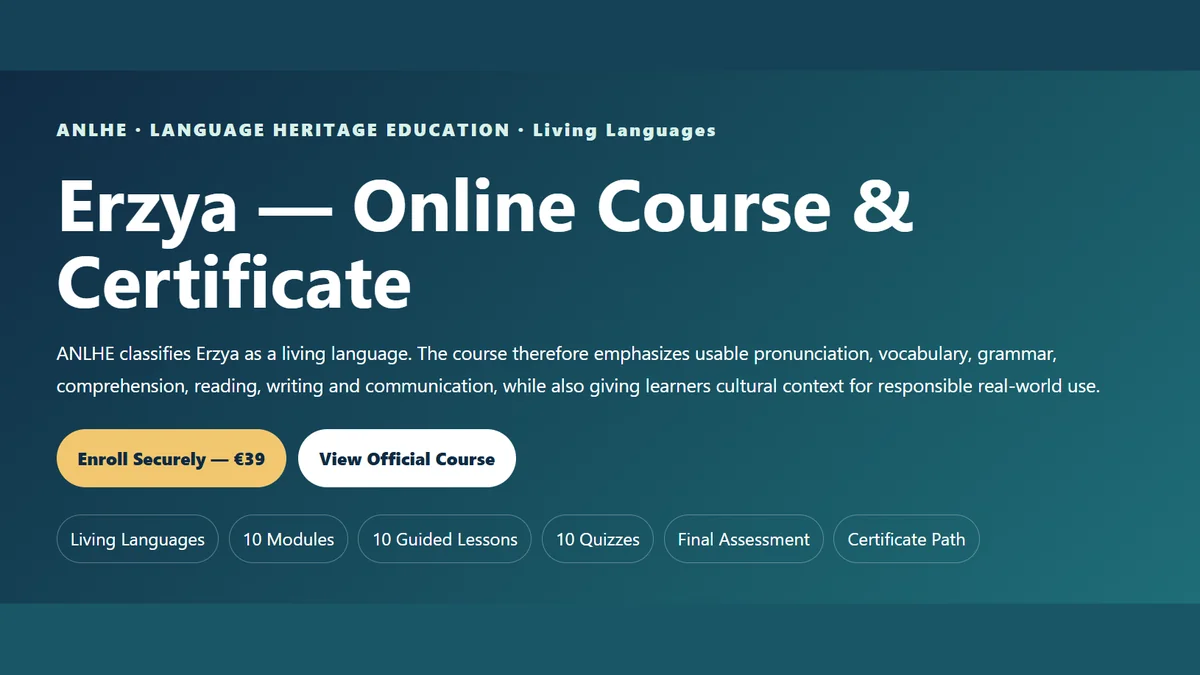
The "Erzya Language Certificate Course" page offers ten modules for a one-time payment of €39: from an introduction to the language and its cultural background through sounds, writing, vocabulary and grammar to a final assessment with a certificate; each module ends with a quiz. The site itself notes that a record of completion is neither a university degree, nor a licence, nor a professional qualification. The page's author is listed as "admin"; as Erźań Mastor observes, it contains not a single Erzya word, no textbooks, no dictionaries and no audio. The Moksha course is built the same way and costs the same.
Erźań Mastor put three questions to the company: how many people have enrolled, who wrote the course — and whether a native Erzya speaker and generative AI were involved, — and which writing system the course teaches. ANLHE's first reply was long and courteous but sidestepped two of the three questions. The company said the course was "in its initial enrollment period", so it was not publishing an enrolment total, and that the course "is presented as an ANLHE institutional program rather than as the work of a single publicly named author". The editors then asked again, in yes-or-no form — and received direct answers.
"Yes. A native speaker of Erzya participated in checking the course material, and the relevant language checks have been completed," the company replied — without, however, giving that speaker's name, qualifications or share of the work. And further: "Yes. Generative AI was used in approximately 35% of the course preparation process. The remaining approximately 65% is based on books, linguistic documents, supporting instructional videos, and human academic and editorial review." How that share was calculated and which parts the AI produced, ANLHE did not explain. The question of the writing system it redirected into the product itself: "the full writing-system treatment is included within the course, particularly in Module 3, 'Sounds, Pronunciation, and Writing System'" — meaning that whether the course teaches Cyrillic or Latin script can only be learned after payment. ANLHE promised the editors reviewer access, warning that activation takes up to a week — "the standard activation period applied to all learners… not a special restriction imposed on Erźań Mastor" — during which "the reference materials, supporting documents, and instructional videos are consolidated and subjected to final human and technical checks". The course, recall, has been on sale since 25 August.
For a prospective learner all this means one thing: before paying, not a single substantive parameter of the course can be verified — who wrote it, who checked it, what sources it rests on, which alphabet it uses and how the language sounds in it. For a major language such a product would vanish among hundreds of others; Erzya has only a handful of courses, and every new one stands out. A learning product for a language without strong institutions rests on trust, and trust is built of verifiable things: a named author, a named native speaker, listed sources, an open sample lesson. Nor is the writing system a technicality here: Erzya today is written in both Cyrillic and Latin script, and a learner has the right to know in advance which one they will be taught.
The news has another side too: a commercial platform judged Erzya worthy of a place among its 444 courses — a signal of demand, and in itself a kind one for the language.
Valks builds its own teaching materials differently: our self-study course is based on Niina Aasmäe's "Kortatano erźaks" (Tartu, 2015), used with the author's permission; the writing system — the Latin orthography of the Nazarenko system — is declared openly; the dialogues are recorded by native speakers; all lessons are free, and they can be examined before any decision to study. We pass no judgement on the content of the ANLHE course while no one has seen it. If Erźań Mastor receives the promised access and publishes a review, we will return to the subject. The very appearance of Erzya in a commercial catalogue shows that the language is being noticed; the community's task is to make sure that what gets noticed is not only the price but the quality.