The stage where Erzya is spoken aloud: ninety years of the national theatre
There is only one place in the world where Erzya speech rings out professionally, publicly and at full voice night after night — the stage of the Mordovian State National Drama Theatre in Saransk. While the language is losing the school, official paperwork and the book market, the theatre remains the one sphere where Erzya is not read silently but spoken aloud — from a stage, to an audience, under the lights. We looked into how this last bastion of the spoken word works, where it came from and what awaits it.
The theatre's history is long and instructive — it contains two births. The first dates to 25 August 1932, when the executive committee of the Mordovian regional soviet resolved to open a national theatre; Moscow's Maly Theatre, one of Russia's oldest playhouses, took the new company under its patronage, and in 1935 the Maly actor A. Kostrov staged the first Erzya-language production in Saransk — Ostrovsky's "The Storm". Then came "Poverty Is No Vice" and "The Power of Darkness": Russian classics in translation, and folk talents streaming into the company from Mordovia and the neighbouring provinces where Erzya and Moksha communities lived. Theatre historians record something remarkable about the touring performances of those years: in village halls "the line between art and life dissolved", and spectators would call out advice to save the virtuous characters. Even in 1943–1944, at the height of the war, the republic sent its young people to study at an opera studio attached to the Saratov Conservatory and a drama studio at the State Institute of Theatre Arts in Moscow. But the first birth carried a congenital defect, which the historians of the Mordovian stage B. Basargin and V. Peshonova state plainly: the national repertoire grew slowly, actors for plays in the native languages were scarce, Erzya- and Moksha-language productions became rarer from the war onward — and for decades even the plays of the national playwrights Kirillov, Abramov and Merkushkin ran mostly in Russian. A national theatre existed; the national language was almost absent from its stage.
The second birth happened where the whole Erzya revival happened — at the end of the 1980s. In 1989, by a resolution of the Council of Ministers of the Mordovian Autonomous Soviet Socialist Republic, a separate national drama theatre was founded: its company was formed of graduates of the Shchepkin Theatre School — the drama school attached to Moscow's Maly Theatre — trained there specifically for this purpose and returned home, and its first production was Alexander Pudin's "The Anchorites, or A Corner for Orphans". The starting conditions say more about the language's place in the hierarchy of the time than any declaration: the new theatre was allotted a semi-basement space with an auditorium of thirty-five seats. Thirty-five. From that semi-basement, over two decades, the theatre made its way to a building of its own in the centre of Saransk — with a portico, columns and metalwork ornament, opened on 21 July 2007 for the First International Festival of Finno-Ugric Peoples. The same birthday, we note, as the second birth of the children's magazine Chilisema, of the Foundation for Saving the Erzya Language and of the newspaper Erzyan Mastor — the late eighties: the whole of today's Erzya infrastructure was born at once, and the theatre is a rare element of that wave that has since grown rather than shrunk.
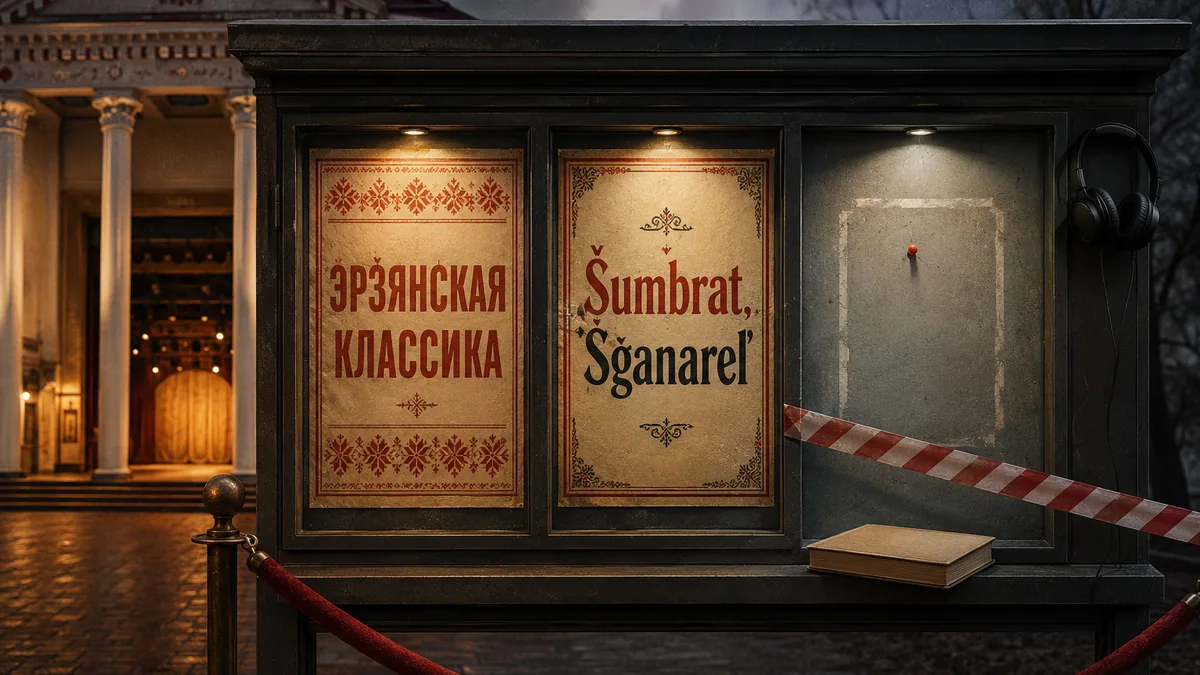
What is the theatre today? The republic's only trilingual stage: more than forty productions in Moksha, Erzya and Russian, and a company of over thirty-five actors. The repertoire policy deserves a paragraph of its own, because the theatre does what Erzya book publishing does not. We wrote recently that there is no translated Molière or Conan Doyle on the Erzya bookshelf — yet on stage an Erzya Molière exists: it was the national theatre that took "Šumbrat, Sganareľ" ("Greetings, Sganarelle", after Molière's "The Doctor in Spite of Himself") to Finland. Alongside it — Eugene O'Neill ("Desire Under the Elms"), Valentin Rasputin ("Ěräk dy iľa stuvtńe" — "Live and Remember"), Vasily Shukshin ("Latoś syrgaś" — "The Roof Has Come Loose"), Vladimir Gurkin ("Sanä, Vanä, martost Rimas", whose Erzya-language premiere opened the 86th season in 2020). The theatre is in effect the only working workshop of literary translation into Erzya: every staging of a world play means that someone has translated its text and actors have spoken and polished it aloud. Recognition comes: the fairy-tale production "Kujgorož" took the Grand Prix of two festivals in 2020, and the theatre has won prizes at Finno-Ugric festivals from Cheboksary to Finland. And one more underrated function: regular tours of the republic's villages and of the diaspora — the Penza, Nizhny Novgorod and Ulyanovsk regions, Chuvashia. For an Erzya village where the native-language class has been closed, the theatre's visit means several hours of full-voiced Erzya environment — a travelling environment, but an environment.
Now for what gives cause for concern. First, the simultaneous translation: Erzya- and Moksha-language performances run with obligatory Russian translation through headsets. It is a wise arrangement that opens the hall to everyone — and at the same time a precise sociolinguistic measurement: the theatre can no longer count on an audience that understands the language without headphones, even in Saransk. The share of spectators "with translation" is a figure worth tracking as an indicator of the language's condition; we fear it is growing. Second, the personnel. The company of 1989 was trained in Moscow by a dedicated intake; those actors are now approaching sixty. Where will the next Erzya-speaking generation of the stage come from, if the native language at school is optional and no drama school teaching in Erzya exists? A theatre can outlive its audience, but it cannot outlive its own company. Third — the repertoire ceiling, and it says more about nationalities policy than any of that policy's declarations. In that policy, everything Erzya is assigned the role of the second-rate and the deliberately archaic: folklore, ethnographic fairy tale, translated Russian classics — by all means; the contemporary drama of kindred nations — no. Plays by the leading playwrights of Estonia, Finland or Hungary are unthinkable on this stage; an Erzya production based on Tove Jansson — the Finnish writer whose Moomins have been translated into dozens of languages — is unimaginable and, in present conditions, simply forbidden. Staging the very same thing in Russian poses no problem at all. The boundary runs not along genre or quality but along language: Erzya is permitted to speak of the past — and not permitted to speak of the modern world.
Our forecast is this. Over the coming decade the theatre will almost certainly survive — the building, the status and the tourist route protect it more reliably than anything ever protected the newspaper or the journal. The question is not existence but language: without a new dedicated intake of Erzya-speaking actors (on the model of 1989 — and this is a concrete, achievable demand on the republic), the stage will drift slowly toward the formula "national in costume, Russian in language" familiar from the theatre's first birth. History, as we have seen, has already been around this circle — and has already shown the way out: it is called thirty-five graduates of the Shchepkin School. Valks, for its part, offers the theatre what it knows how to offer: an open dictionary as a working tool for translators of plays — and we will be glad if the next Erzya Molière, Chekhov or, who knows, Agatha Christie is born with it at hand. And to readers who find themselves in Saransk, our appeal is simple: buy a ticket to an Erzya performance — and leave the headphones behind.