
A grandmother's silence: where the fate of the Erzya language is really decided
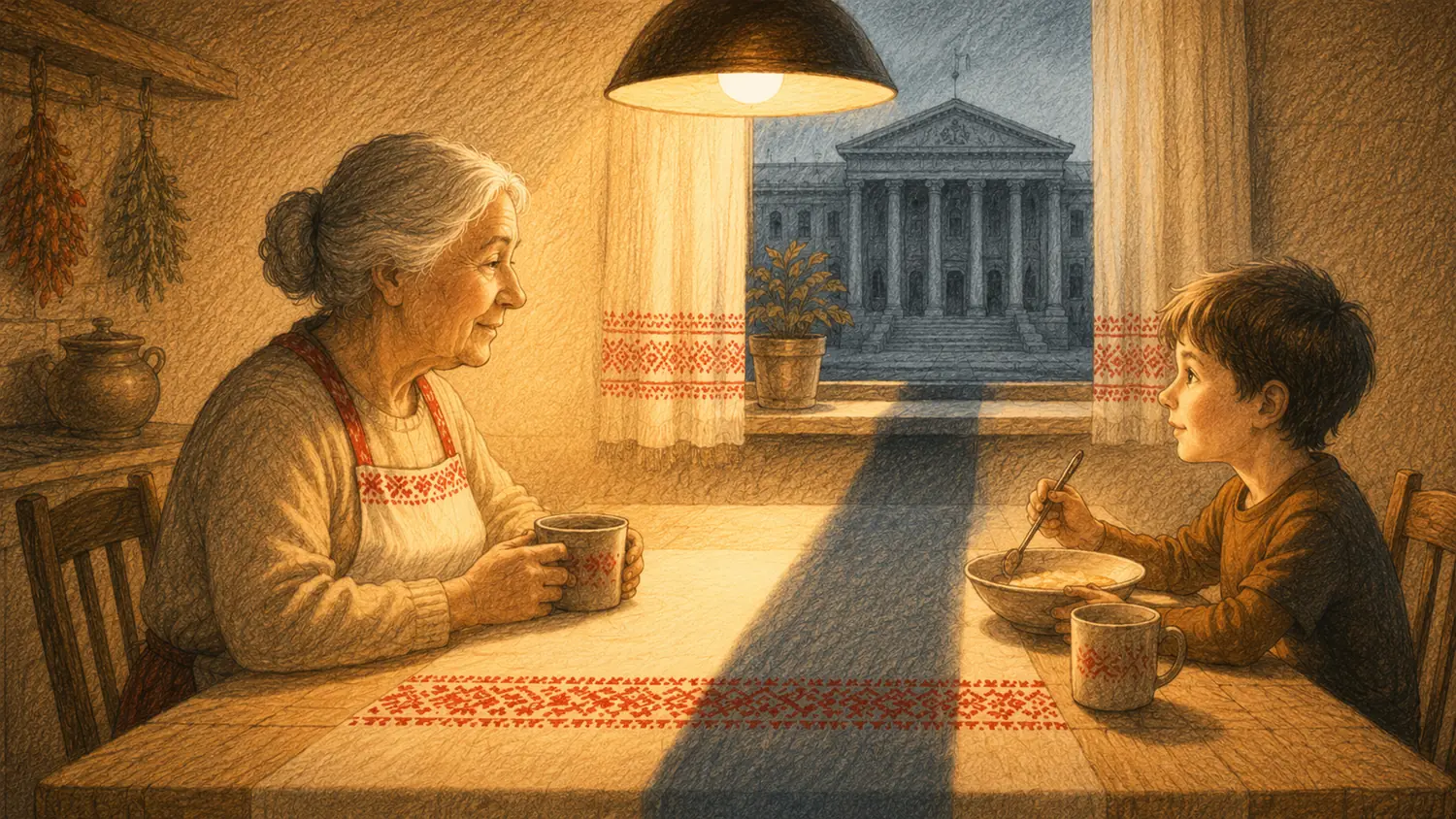
Language shift does not happen by itself — it is organised. The state that made the native language optional at school, and cleared it out of official paperwork, the clinic and the airwaves, has spent decades building conditions in which an Erzya child can only grow up Russian-speaking — and then throws up its hands: the families, it says, simply do not pass the language on. The end point of this policy does indeed lie at the kitchen table — where a grandmother who speaks fluent Erzya addresses her grandchild in Russian: "so he doesn't get confused", "so school will be easier", "what does he need it for, he'll leave anyway". But her quiet decision is not the cause of the shift; it is the last link in a route mapped out long before her and not by her. Today's article is about the most important and least studied sphere of the Erzya language's life: the family — on which the responsibility was placed after the tools had been taken away.
Begin with an honest admission: the modern Erzya family is the least studied of all the spheres of the language's life. Scholarly work on families' language choices does exist — there is, for instance, the study "The Language Choice of Mordvin Families in a Situation of Ethnic Minority", which traces how historical circumstances pushed families toward Russian — but no large-scale contemporary survey has ever established in what language thousands of Erzya families speak to their children today, and why. The contrast with the neighbours is telling: in 2019–2021 a thorough study of language biographies was carried out among the Mari of the Urals, with questions precisely about communication within the family and transmission between generations. The Erzya family is still waiting for such a study, and that is this article's first conclusion: the most important sphere of the language's life is the least examined.
Something can nevertheless be seen through indirect measurements. The 2010 census recorded — the figures are given by the Great Russian Encyclopedia — that over 99 per cent of Mordvins had command of Russian, and 35.2 per cent named it their mother tongue; only 54 per cent had command of Erzya and Moksha. Consider the first pair of numbers: every third person recorded as a Mordvin already considered Russian their own language back then. That is what the statistical trace of the kitchen-table decision looks like: a language learned from one's parents, not passed to one's children, and reclassified as "grandmother's". On the other side stands a figure we discussed in our analysis of the census: the number of people naming Erzya specifically as their mother tongue rose from 36,700 to 40,000. Behind each of those forty thousand answers there also stands a family decision — of the opposite sign.
Why does a loving grandmother choose Russian? Here one must resist the easy answer. She is not "betraying the language" — she is responding rationally to a system of incentives built by someone other than her. Since 2018 the school has not required the native language; university, work, the city, the army and the clinic speak Russian; the teacher tactfully advises "not to overload the child"; television allots Erzya seven per cent of airtime. In such a system, passing the language to a child looks like an extra burden with no visible reward — and the family, the most sensitive economist in the world, makes the logical choice. The sociolinguist Joshua Fishman, who built the famous scale of language shift, insisted on precisely this: as long as a language is passed from parents to children, it lives under any circumstances; once the transmission breaks, no holidays, signage or television channels will replace it — they are only prosthetics. All the state "support", concentrated on symbolism, bypasses the single node where everything is decided — and, as we wrote back in April, the state has effectively placed the responsibility for preserving the language on the family, while taking away from the family every reason to bear that responsibility.
But there is another side, and it gives hope. Where a family nevertheless makes the opposite choice, the result is visible a generation later. The LES portal told the story of Alexey Krotov from the village of Shkudim in the Penza region — a blogger who took the pen name Leksey, from the Erzya word "leksems", to breathe: his parents taught him the native language from birth, and now, as a grown man, he is polishing the literary standard on his own, following the Erzya television programmes "Siyazhar" and "Kulyat", subscribing to the literary journal Syatko, buying books. "I can say with confidence that it is beautiful, warm and melodic," Leksey says of the language he uses "mainly in the family, in my home village and at national festivals" — and which, in his words, he would like to use at official gatherings too. The headline of that piece speaks for itself: "National identity today rests on the patriots of the language." Note the mechanics: the family gave the language, and the infrastructure — the journal, the broadcasts, the books, the dictionaries — allowed him to keep and complete it. Neither works alone: a family without infrastructure raises a speaker with no one to talk to and nothing to read; infrastructure without the family broadcasts into a void. They only work together.
There is also the reverse route — when it is not the family that leads to the language, but the language that leads back to the family. The activist Arpad Valdazh, who grew up in Saransk and now lives in Armenia, told an independent outlet how he came to Erzya by a roundabout path: as a teenager he stumbled on Hungarian songs and comments online, grew fascinated with the Finno-Ugric languages — and through them returned to his own roots. Returned actively: he wrote the first physics textbook in Erzya — the rarest of cases where a textbook was created in a language of one of Russia's peoples from scratch rather than translated from Russian. His testimony also shows what a family that decides to read in Erzya runs into: in a Saransk bookshop there are "literally two shelves of Erzya books", and the national epic "Mastorava" in Erzya is "simply impossible to buy in Mordovia". A family that chooses the language runs straight into the emptiness we described in our articles on the children's bookshelf and on publishing — one more argument for the same conclusion: the family's choice and the infrastructure's work can be separated only on paper.
What follows in practice? For the family — three things that sociolinguistics repeats to every small-language community in the world. First: the fear that a second language will "overload" a child is not supported by science — decades of research on childhood bilingualism show that bilingualism in itself causes neither delays nor speech disorders, and bilingual children develop within the normal age range; the child will pick up Russian in any case, out of thin air, whereas Erzya will come only from you. Second: a language is passed on not through lessons but through daily life — a lullaby, a quarrel, a soup, a nickname; fifteen minutes of Erzya over supper are worth more than a Sunday class. It is no accident that the first lesson in the classic Erzya courses printed in the children's magazine Chilisema is called "Mon dï moń kudoraśkem" — "Me and my family": the language itself remembers where it begins. Nor is it an accident that the folk storyteller Serafima Lyulyakina, explaining her love for her native tongue, compared the Erzya language to a white birch, a flowing river and a nightingale singing at full voice — every one of her comparisons comes from the world a child is shown at home, not in a ministry. Third: the decisive age is before school; what is put in before seven, school can no longer take away, and what is put off "for later" never arrives. For the infrastructure — ourselves included — something else follows: our work makes sense exactly to the degree that it lowers the price of a family's choice in favour of Erzya. A dictionary, a children's magazine, a song, a play, a translated fairy tale — all of these are arguments on the grandmother's side of the scales.
Valks ends this article not with a conclusion but with a request. We want this subject to have not only arguments but voices: tell us what language is spoken at your table — and how it came to be that way. How your parents decided, how you decide, what you regret, what you are proud of. The most important studies of the Erzya family have not yet been written — but they can begin with letters.