
No school, no street: how families pass small languages to their children
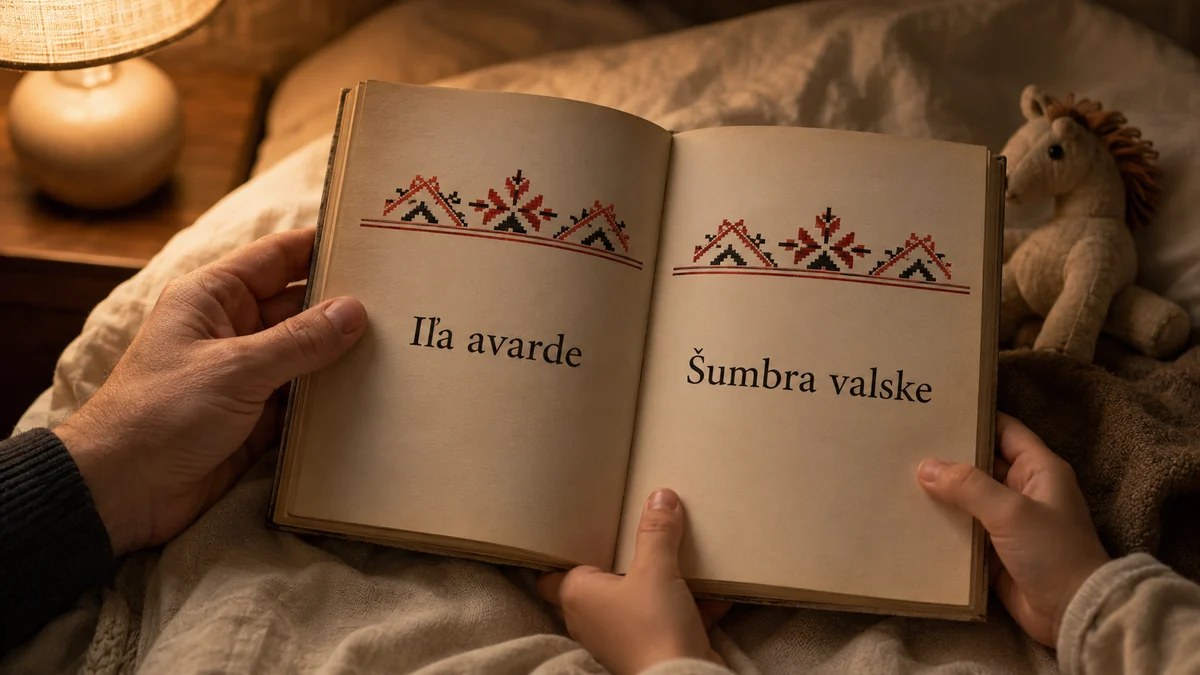
How do you tell a child "don't cry", call them to lunch, help them dress or put them to bed in a language that can hardly be heard anywhere around you? For a family that has decided to pass such a language on to its children, it is these everyday phrases that matter more than solemn speeches or textbook passages. A language enters a child's life not through a lesson but through mornings, meals, play, walks — the small domestic actions repeated hundreds of times.
On 28–30 August 2026, the Estonian seaside village of Võsu will host the summer school of Fenno-Ugria, the Estonian organisation devoted to the Finno-Ugric peoples, under the title "Identity and Exile: What Can We Do?". The programme features two family stories of passing on small languages. On 28 August, Janis Mednis will speak on "My Livonian-speaking family" — about raising children in Livonian, a Finnic language of Latvia that today has only a handful of speakers. On 29 August, Aleksandr Ryabchikov and Valentina Nikolaeva will present the experience of a Mari-Udmurt family: according to the organisers, all four of their children speak both Mari and Udmurt, although the family lives far from its familiar language environment. Registration for the school is open until 1 August.
Janis Mednis and Renate Medne began learning Livonian before their elder daughter was born, and then made it the language they speak with their children: as the family told the Estonian outlet Koiduaeg, the parents speak only Livonian with their daughters, and occasionally Latvian with each other. No ready-made materials existed for life with a baby in Livonian, so a week before their firstborn arrived the couple started writing down a practical vocabulary of their own: phrases for waking up, getting dressed, brushing teeth. "You simply have to speak the language. There is no other way," they explain. Out of those notes grew the book Kūldaläpš — "Golden Child" — published by the Livonian Foundation (Līvõd fond) in October 2022.
The 72-page book is organised around fourteen everyday themes: "Good morning", "Don't cry", "Lunch", "Play", "Bath", "Evening", "The body", "Birthday" and others. Each chapter offers words and phrases, a short grammar note, and a song, poem or counting rhyme. The material is aimed not only at the child: parents learn the language alongside them and put the new vocabulary to use at home straight away. The authors were assisted by the Livonian language specialists Tiit-Rein Viitso, Tuuli Tuisk and Erika Krautmane; the book was illustrated by Kristine Kutepova.
The Mednis family's story exposes the limits of the familiar model of language learning. A dictionary can explain what a word means and a grammar can explain its form, but neither tells a parent what to say during bath time, feeding or the morning rush. When a language is almost absent from kindergartens, shops and the street, a family has to build an entire domestic environment for it on its own. It was precisely the lack of materials about life with a small child that brought Kūldaläpš into being.
The Mari-Udmurt family of Ryabchikov and Nikolaeva is a different case: here the children are receiving both of their parents' languages at once. For now, Fenno-Ugria reports only the essential fact — all four children speak both. What rules the family follows, how the languages are divided between the parents, and what helps the children hold on to them far from their home environment, the participants will explain at the summer school; firmer conclusions about their method will have to wait for the talk or its recording.
For families speaking Erzya — the Finno-Ugric language of the Volga region to which this portal is devoted — the question is built the same way. The appeal "speak Erzya with your children" is not enough on its own if parents have no ready phrases, no audio recordings, no children's texts and no clear path from first words to steady conversation at home. A family can become a language environment — Valks wrote about this in its article on where the fate of Erzya is really decided — but for that it needs tools assembled around real life, not only around school topics.
The Livonian family's experience also points to a possible direction for Valks itself: a family phrasebook built around the situations of the day — waking up, getting dressed, meals, requests, play, how you feel, walks and bedtime. Each theme could bring together short phrases, audio recorded by native speakers and links to dictionary entries, just as our self-study course already does. The dictionary would then not only answer the question "how do you say this in Erzya" but help make Erzya the language of everyday conversation. We will be following the talks in Võsu — above all the experience of the bilingual family, which speaks especially closely to Erzya-Russian households.