It hurts — in Erzya: a language with words for pain, and a medicine that does not hear them
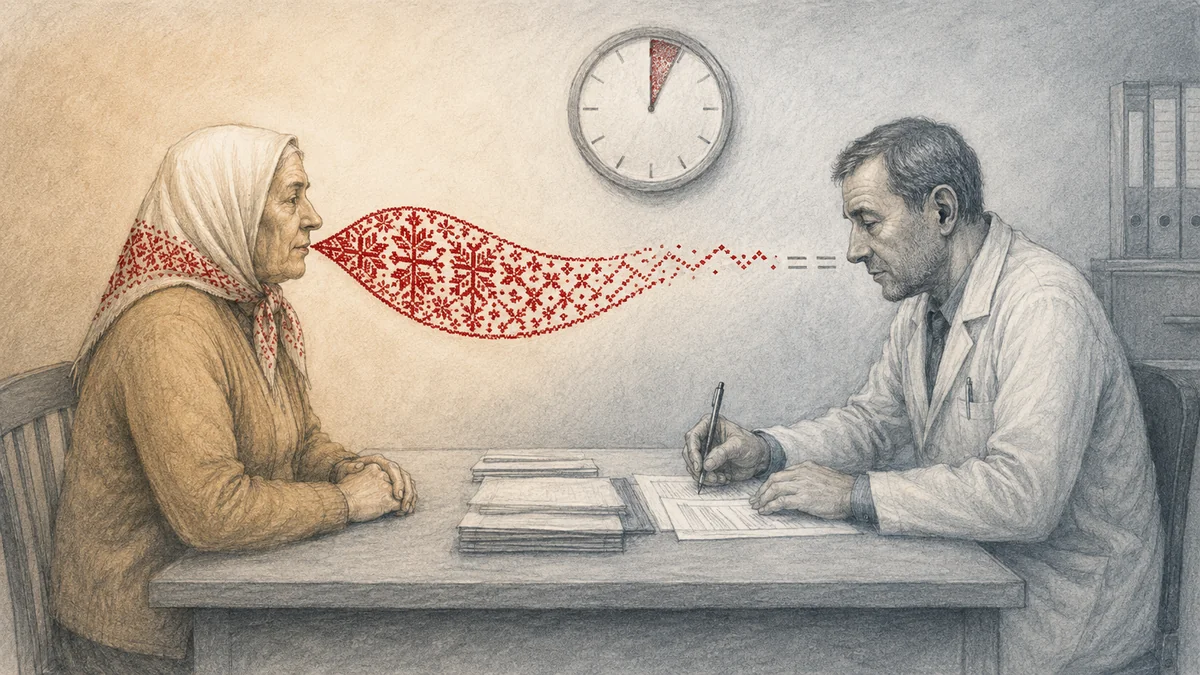
Picture an elderly woman from an Erzya village at a doctor's appointment. All her life she has thought, counted, prayed and complained about her health in Erzya; her Russian is the school-taught, formal kind, kept for dealings with officialdom. She needs to explain exactly how it hurts — whether it pulls, burns, stabs or radiates — and these are the subtlest words of any language, the ones a person chooses without thinking only in their mother tongue. The doctor listens in Russian. Between the symptom and the diagnosis stands a translation that the patient performs herself — old and ill, in a consulting room where twelve minutes are allotted for it. Today's instalment of our series is about the sphere in which the Erzya language is entirely absent: medicine.
Begin with the legal frame, because it is especially telling. Under a law of 1998, Erzya is one of the state languages of the Republic of Mordovia. A state language, by the very meaning of the term, has a place in state institutions — and the hospital and the clinic are state institutions. Yet, as reference descriptions of the language record, in reality it is used "only in the texts of laws, and even there to a limited extent". No reception desk, no "Room 5" sign, no vaccination leaflet, no consent form, no health poster on the wall — nothing of medicine's daily paper and spoken routine exists in Erzya; we could not find a single mention of even one hospital or consulting room where patients are seen in Erzya. The state language ends at the threshold of the state hospital.
At the same time, it cannot be said that Erzya "lacks the words" for medicine — and this point matters. Academic descriptions note that medical vocabulary of the "tablet" and "injection" kind is borrowed from Russian — as it is in most of the world's languages, which have absorbed the international nomenclature. But the basic layer — the body, pain, illnesses, states — exists in the language and is recorded in dictionaries; even a dictionary compiled by the efforts of the national movement readily supplies Erzya equivalents for concepts including delicate medical ones. A precedent for building modern terminology also exists, and we have written about it: in the 2010s the international project Terminologia scholaris created school terminology in Erzya for ten subjects — work that showed both the scale of the task (native terms accounted for between 11 and 33 per cent, depending on the discipline) and its feasibility. Terminology is a matter of technique; making it needed is a matter of politics.
Now to why the linguistic void hurts most of all precisely in medicine. The demography of Erzya speakers is well known: above all, the older generation and the countryside. In other words, the typical person who needs Erzya in a doctor's office is the typical patient of a rural hospital: elderly, with a cluster of chronic conditions, often alone. And here medicine knows a cruel turn that geriatric specialists have long described: in dementia and age-related memory disorders, the later-learned language goes first — a person who has spoken Russian for decades returns to the language of childhood. A grandmother who "managed perfectly well in Russian" all her life may, in the most vulnerable condition of her life, become an Erzya speaker again — inside a system where no one will understand her. For languages whose core speakers are elderly, medicine is not "one sphere among others" but the last sphere where the language is needed in the most literal, vital sense.
It is not like this everywhere. In Finland, a patient's right to receive care in their own language — Finnish or Swedish — is enshrined in law, and for the Sámi there is a separate language act; bilingual reception desks and leaflets there are not a feat but a standard of how state institutions are run. No one demands that every doctor in Mordovia learn Erzya — what is at issue is modest and achievable: bilingual signs and leaflets in the hospitals of Erzya districts, health posters in two languages, a short medical phrasebook for staff ("where does it hurt?", "show me", "how long?"), a note at the reception desk that the patient is more comfortable in their native language — and taking Erzya into account when young doctors are assigned to villages. Not one of these steps costs any real money. All of them cost only one thing: the recognition that a patient has the right to be ill in their own language.
Valks sees a task of its own here as well: the vocabulary of the body, pain and health belongs to those sections of a dictionary that are needed not by philologists but by people, and we will give it particular attention, including live examples of usage. And of our readers in medicine — Erzya in white coats, wherever you work — we ask something simple: if your patient switches to Erzya, do not correct them. They may, at that moment, be speaking to you in the only language in which pain is called by its true name.