Ariste's journal shrinks by half: what Linguistica Uralica means for the Erzya language
From 2026, the Tallinn journal Linguistica Uralica — the oldest periodical in world Uralic studies — comes out twice a year instead of four times. The news sounds mundane, like a line from a publisher's schedule, but behind it lie sixty years of history in which the Erzya language has a chapter of its own, and a worrying question about the future of a scholarly field for which our language is not "regional material" but a subject in its own right.
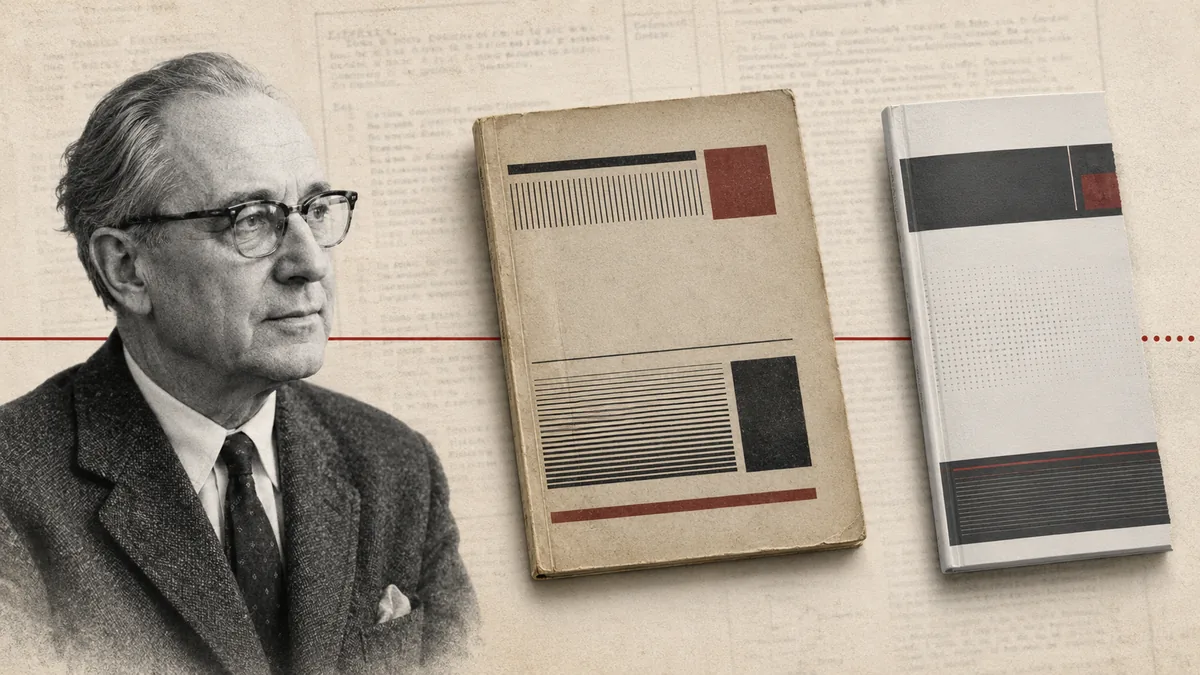
One has to begin with the founder. The journal was created in 1965 by Paul Ariste, the Estonian academician and an era-defining figure of Finno-Ugric studies. A blacksmith's son from the parish of Torma, a polyglot, a scholar of Estonian, Votic, Udmurt, Yiddish and Romani, the author of some 1,300 works, Ariste turned the department of Finno-Ugric languages at the University of Tartu into a recognised centre of learning for the Finno-Ugric peoples: dozens of doctoral students from the Volga and Ural regions trained under him and returned home with their degrees. Ariste founded the journal — called Sovetskoe finno-ugrovedenie, "Soviet Finno-Ugric Studies", until 1990 — as a shared platform for the whole field, and he remained its editor-in-chief for twenty-five years, to the last days of his life. In 1990, with the founder's death and at the turn of an era, the journal received its present name, Linguistica Uralica, and continued to appear in Tallinn under the auspices of the Estonian Academy of Sciences, publishing articles in English, German and Russian.
For the Erzya language, this journal performed a special service throughout all six decades: it was the bridge across which the linguistics of Saransk reached the world, and world linguistics reached Saransk. On its pages Erzya was examined as a fully fledged European language — from historical phonetics and dialectology to the most unexpected subjects. Here appeared studies of Mordvin–Tatar language contacts in the Volga region — shared vocabulary, place names, personal names and nicknames (2013); of lexical innovations in the Erzya translations of the Lord's Prayer — three centuries of translation tradition under the linguistic lens (2017). And the report on the international project Terminologia scholaris, published by the journal in the mid-2010s, produced figures that deserve to be carved on the wall of every ministry: when school terminology for ten subjects was developed for Erzya, only 32.6 per cent of the linguistic terms proved to be native, 11.4 per cent of the literary ones and 14.7 per cent of the historical ones — the remainder were borrowings. A journal published in Tallinn spent decades recording what was happening to the vocabulary of a language in Saransk — dispassionately and precisely.
Something else deserves separate mention — what the journal has done in recent years: since December 2021, all accepted articles have been published under the free CC BY licence. For a small academic periodical this is an act of principle — and a gift to projects like ours: research on the Erzya language appearing in Linguistica Uralica can now be freely read, translated and cited. In an age when access to scholarship is increasingly paywalled, the oldest journal of Uralic studies chose openness.
Now, to what has happened. The publisher has announced that from 2026 there will be two issues instead of four, appearing on 20 June and 20 December. The editors have given no public explanation, and we will not invent one for them. But the context in which the decision was taken is visible to the naked eye. World Uralic studies is a small discipline, and it is living through a hard decade: university chairs of Finno-Ugric studies in Europe are being cut back or closed, and after 2022 many academic ties were severed between European centres and Russia — the country where most speakers of the Uralic languages live and most of their researchers work. For a journal whose mission is to connect those two worlds, every broken contact means an article that will never be written. Halving the frequency — whatever its immediate causes — means half as many pages for all the Uralic languages, Erzya included: fewer publication venues for authors from Saransk, fewer reviews of Erzya books, fewer occasions for the world to remember our language.
Why should this matter to the Erzya reader in particular? Because outside scholarship is part of a language's life-support system. As long as Erzya is described, compared, reviewed and cited in Tallinn, Helsinki and Budapest, it remains a subject of world linguistics rather than a "regional peculiarity". Ariste's journal held that frame in place for sixty years. Its shrinking is not a catastrophe, but it is a signal: the outside mirror in which the Erzya language saw itself as European is getting smaller, and relying on it alone is no longer an option.
Valks will draw a practical conclusion. We will add the Erzya publications of Linguistica Uralica — now, fortunately, open — to the project's bibliography and will report on each new issue: two issues a year are, after all, two guaranteed occasions a year. And the duty to build our own venues, where the Erzya language is studied and described independently of anyone else's publishing schedules — that duty remains ours.