The shelf that ends at ten: the Erzya language and its young reader
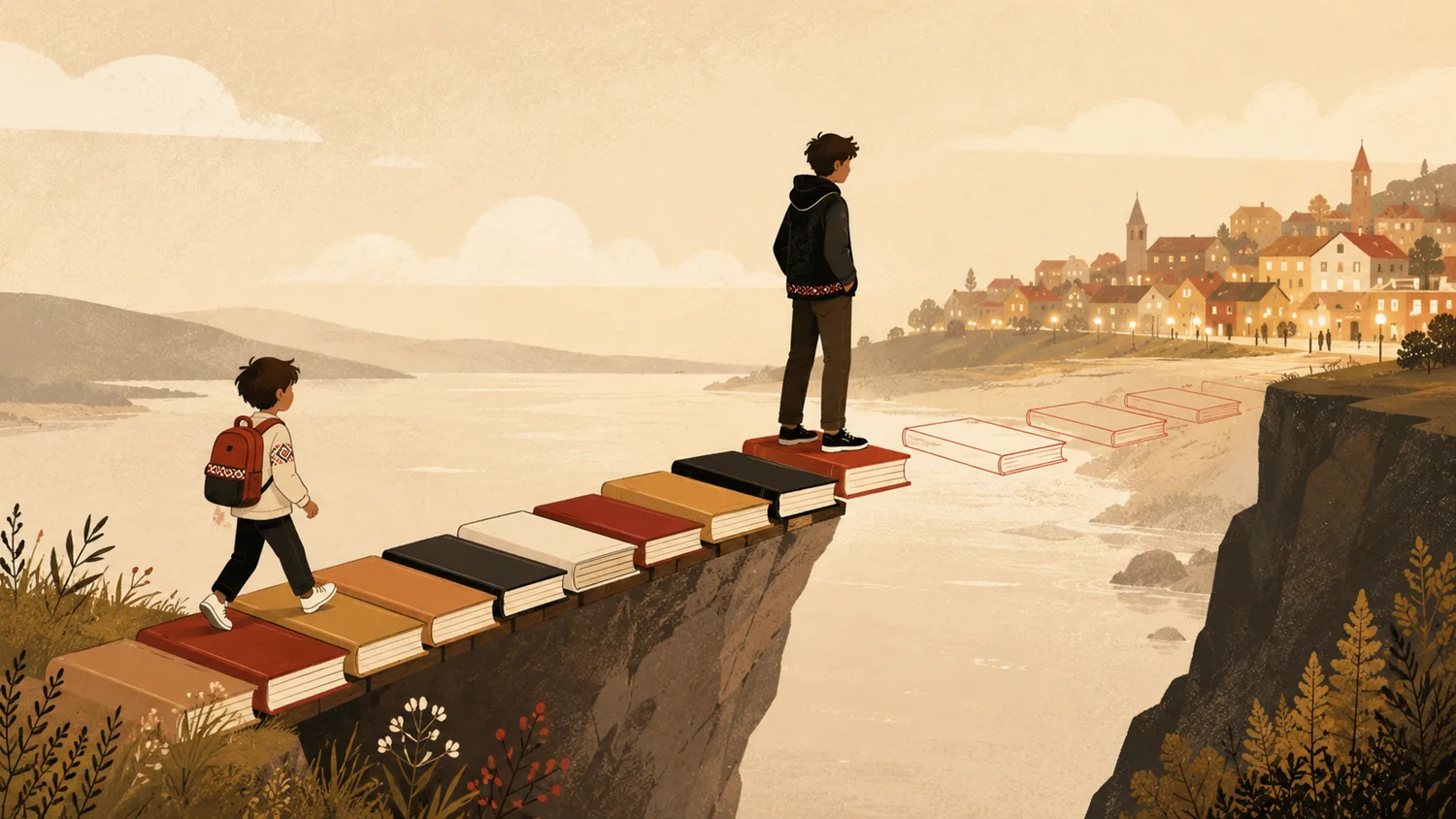
The Erzya language has a children's magazine older than nearly all of its readers put together — and almost no books for anyone past the age of ten. Between the children's monthly Chilisema and the adult literary journal Syatko lies a void the size of the most important age of all: the age at which a person decides who they will be — and in which language.
Start with the magazine, because it deserves it. Chilisema ("Sunrise") has been published in Saransk since November 1931 — first as Yakstere Teshktine ("Little Red Star"), then as Pioneren Vaigel ("The Pioneer's Voice"), and under its present name since 1991. Its pages, in the words of the encyclopaedia, carried "virtually all the founders of Erzya prose and poetry". Today it is the only children's and youth magazine in the Erzya language; it has subscribers in nearly thirty regions of Russia and readers abroad. And now the numbers there is no hiding from: the print run of the 1930s reached one and a half thousand copies; the print run today is around 1,200–1,300. In ninety years the magazine has not grown by a single copy. According to independent media reports, falling readership has put Chilisema under threat of closure.
The magazine, meanwhile, holds a special place in Erzya history — one larger than children's literature. In the late 1980s it was the editorial office of Chilisema that became the assembly point of the Erzya national revival: around the magazine's executive secretary, the poet and folklorist Mariz Kemal, gathered the intellectuals who formulated the thesis "kavto keľť — kavto raśkeť" — "two languages, two peoples". A children's magazine turned out to be the headquarters of an adult movement — probably because it was one of the very few places where one could think and work in Erzya every single day. For more than thirty years, from 1987 until his death in January 2021, the magazine was led by the poet Nikolai Ishutkin — author of "Chamomile Glade" and other children's books, the man on whom Chilisema quite literally rested.
What can a seven-year-old read in Erzya today? Not so little, in fact: a magazine of fairy tales, poems and puzzles; children's collections by Erzya poets; folklore, alphabet books and school textbooks; more recently, exercises on the educational platform iSmart. The little one's shelf is modest but alive.
Now ask the same question about a thirteen-year-old. There is no young-adult fiction in Erzya. No adventure novel written for today's teenager, no fantasy, no science fiction, no comics, no detective story — we recently devoted a separate article to that last absence. Nor are there translations of what teenagers read in every living language: no Tolkien, no Rowling, not even Jules Verne. The adult Syatko is not addressed to thirteen-year-olds; Chilisema, to them, is already "for little kids". The reading biography of an Erzya child breaks off at roughly the point where their own choices begin. And this is not only a question of literature: even finding the Erzya books that do exist is an adventure — readers report that at times they cannot be found even in the bookshops of Saransk.
There is one bright spot on this map, but its address is unexpected. In 2021, Saint-Exupéry's "The Little Prince" — the most translated children's book on the planet — came out in Erzya. It was published not by the Mordovian Book Publishing House but by the German publisher Edition Tintenfass, within a project by the Swedish linguist Yair Sapir to translate the tale into the Finno-Ugric languages of Russia; an Udmurt version appeared at the same time, a Komi one later. A picture familiar to our readers: the Erzya self-study textbook is made in Kazan, "The Little Prince" is published in Germany. Where a working institution exists, an Erzya book appears; the only question is why such institutions are absent precisely where Erzya children live.
Why is the young-adult shelf the most important spot in the entire infrastructure of a language? Because that is where the transmission of the language is decided. The census of 2020–2021 recorded only about 46,000 people who named their language specifically as Erzya; a language a child hears from their grandmother but has nothing to read in at thirteen becomes the language of childhood — warm, beloved and left behind. A teenager goes where the stories are about them — and today all of those stories speak to them in Russian. Grown-up holidays and declarations will not change that; the only thing that can change it is a shelf with an Erzya Tolkien on it.
The good news is that this shelf is within reach. The world's young-adult classics, from Verne to Jack London, have long been in the public domain — they can be translated and published freely, in print or online; the experience of "The Little Prince" shows that the translators exist. Valks is ready to serve as a working tool for every such translation — and one can begin with a simple act available to any adult reading this article: a subscription to Chilisema today pays for the existence of an Erzya reader tomorrow.